
Checking Criminal History in Flint
Begin with the office that made the Flint record. The Flint Police Department keeps its incident and arrest reports, while the city Department of Law handles existing-record requests under FOIA. The 67th District Court Fifth Division holds Flint misdemeanor cases and the first stage of felony cases. A felony that is bound over continues in the 7th Judicial Circuit. Statewide public criminal history comes from the Michigan State Police, not Flint police.
- Use Flint Coplogic only for an eligible recent no-suspect, non-emergency incident, and keep the case number returned after review.
- Ask the City of Flint for an existing police complaint, crash file, or other identified record through its written FOIA route.
- Search the 67th District Fifth Division docket for city misdemeanors and felony preliminary events, using a case number when possible.
- Call Genesee County inmate information for current custody, then check the 7th Circuit file if a felony moved beyond district court.
- Use ICHAT for a separate public Michigan name check, knowing that it is not the Flint report or full court file.
The Flint search order can change with the question. A recent Flint custody check belongs with corrections first. A certified Flint outcome belongs with the clerk. For broader county routes, the Genesee County criminal history overview explains how these layers connect.
Flint Coplogic Report Records
Coplogic is a narrow reporting channel, not a search of all Flint criminal records. It accepts qualifying events with no known suspect when the matter is not an emergency. The event must fall within Flint’s reporting scope, and state-highway incidents are excluded. A filer needs an email address and Michigan identification. After police review, the system returns a Flint case number and a printable report copy.
Do not use the Flint portal to report an emergency or an event with a known suspect. Flint agency boundaries matter as well. A Flint mailing address does not prove Flint PD took the report, and a state-highway event may belong to another agency. If the portal rejects an event, identify the agency that responded before sending a public-record request. That step keeps a Flint search from going to the wrong office.
Flint Police Department Records
Flint PD operates from 210 E. Fifth Street and can be reached at 810-237-6800. Its work includes patrol, traffic, a downtown beat, and detectives assigned to property and person crimes. The Major Crimes Unit also works with Michigan State Police. Those units may create reports, supplements, evidence logs, and investigative material, but a request still goes to the city record channel rather than directly to a detective.
For an existing record, submit a Flint FOIA request to the City Department of Law at 1101 S. Saginaw Street, third floor. The city form asks for the requester’s name, signature and date, address and phone, then offers Traffic Accident, Complaint, or Other choices. A precise Flint request also gives the report number, involved person, location or cross street, date, and a clear description of the event.
Some Flint material may be redacted or withheld under Michigan law, especially protected personal data or information tied to an active investigation. Ask for an identifiable Flint record rather than a broad history. Flint PD expressly does not produce criminal-history records. It directs that separate request to Michigan State Police ICHAT.
The city’s public-safety programs are described through the Community Violence Intervention and Prevention Initiative. The official source below shows the local setting in which Flint agencies and community partners address violence.
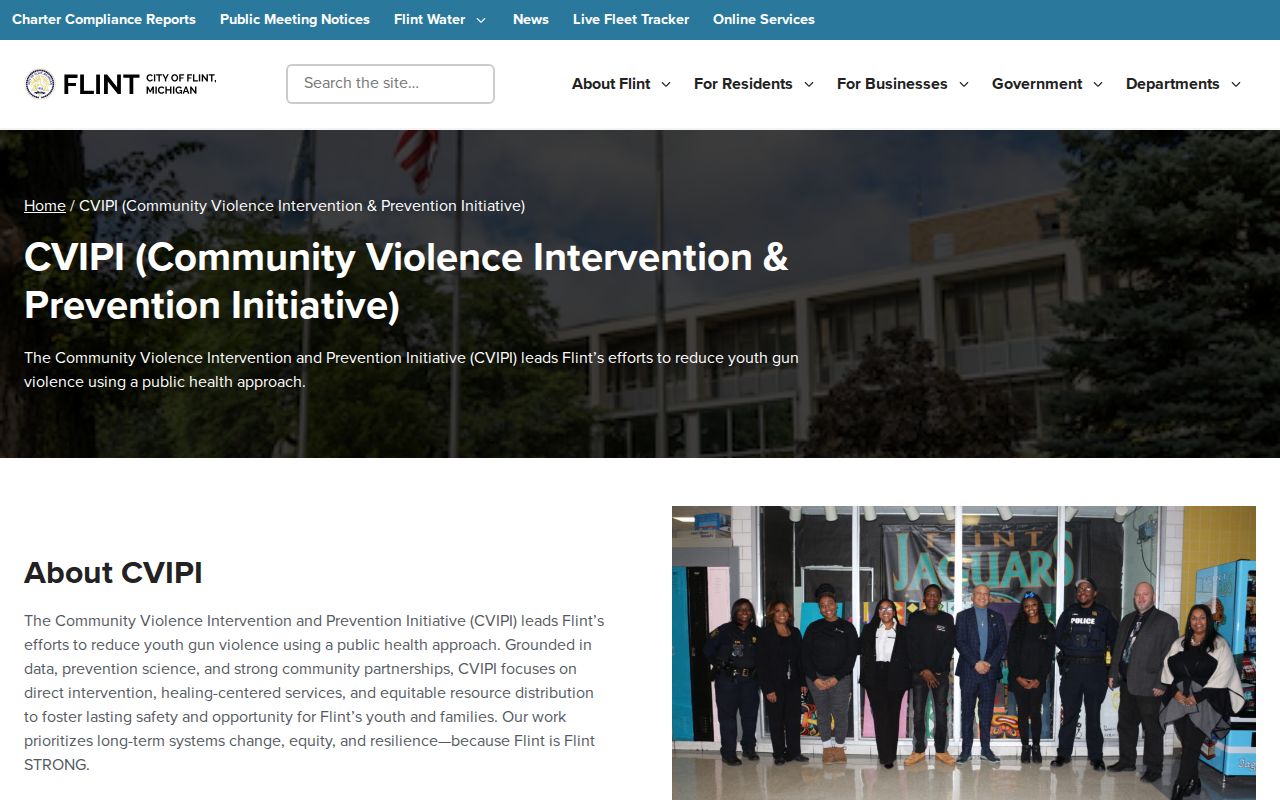
Program news may explain agency priorities, but it does not replace a police report, booking record, or court disposition.
Flint Major Crimes Record Routing
A serious Flint investigation may involve Flint detectives, Michigan State Police, and the county prosecutor. Each participant has a different role. Flint PD creates its investigative file. MSP may create or retain records tied to its own work. The prosecutor decides what Flint charges to file, and the court records those charges and later events. A single request to Flint cannot produce every record in that chain.
The city has also announced grant awards for Flint violence-prevention work. The official grant announcement provides context for these partnerships.

That civic program source helps identify Flint initiatives, while a named incident must still be traced through police, prosecutor, and court custodians.
Flint Arrests and Bookings
Flint arrests can pass through the Sheriff-operated Flint City Lockup or the Genesee County Jail. No stable official public booking-log interface was verified for the county. For current inmate information, call 810-257-3426. The line answers a custody question; it does not provide the full Flint police narrative or prove the final charge and outcome.
A Flint booking record reflects intake, the arresting agency, charges or holds presented at that point, bond information, and release data when available. Flint charges may change after prosecutor review. If the person is no longer in custody, request an identifiable booking record from corrections and search the correct court docket. The full county arrest workflow appears on the Arrest Lookup page.
Keep the Flint report number, booking details, and court number separate so each office can find the right local record.
Note: A Flint arrest is not proof of guilt, and a Flint booking label may not match the charge filed in Flint court.
Flint Offense and Arrest Records
Four records can grow from one Flint event. CrimeStat may count the reported offense. Flint PD may create an incident and arrest report. County corrections may create a booking entry. The court creates a case only after a charge is filed. These records measure different acts and can carry different dates, labels, and totals.
| Flint record | What it confirms | What it cannot prove alone |
|---|---|---|
| CrimeStat count | An offense was counted in city statistics | That an arrest or conviction followed |
| Police report | Flint PD documented an event or arrest | The final filed charge or outcome |
| Booking record | A person entered custody on listed charges or holds | That the court convicted the person |
| Court file | Charges, hearings, disposition, and sentence by count | Every fact in the police investigation |
Use the Flint record that answers the question, then compare later stages when the result matters. This prevents offense totals from being read as arrest totals and keeps a booking allegation separate from a court judgment.
Reading Flint CrimeStat Records
Flint’s official 2025 CrimeStat totals report 34 homicides, 127 robberies, 1,632 aggravated or felonious assaults, 482 burglaries, 809 larcenies, and 392 vehicle thefts. These figures describe offenses counted by the city. They are not totals of people arrested, booked, prosecuted, or convicted. One incident may yield no arrest, and one arrest may involve more than one alleged offense.
Use CrimeStat for local trend context, then use a report number, case number, or date to find a specific Flint record. The distinction prevents a common error: city crime counts cannot confirm an individual’s history. Flint has also published an expanded public-safety plan that gives current context for enforcement priorities.
The plan explains local policy direction, while official reports and court files remain the sources for a named event.
Municipal Court Records in Flint
Michigan does not use a separate Flint municipal criminal court. Flint cases start in the 67th District Court Fifth Division at the McCree Building, 630 S. Saginaw Street, Flint, with a main contact of 810-766-8968. District court handles Flint misdemeanors, arraignments, bond decisions, probable-cause conferences, and preliminary examinations. A felony supported for bindover moves to the 7th Judicial Circuit.
| Court Name | 67th District Court, Fifth Division; later felony proceedings use the 7th Judicial Circuit. |
|---|---|
| Case Types Heard | Misdemeanors, traffic and local matters, plus felony arraignment and preliminary stages. |
| Case Lookup Channel | D67 and MiCOURT searches; call or write the clerk for older or unavailable files. |
| What the Docket Shows | Case number, filed charges, dates, hearings, bond, disposition, sentence, and register entries where public. |
| Copies & Fees | District copies are $1 per page and certification is $10; confirm the current quote before ordering. |
A docket is an index, not always the underlying document. Ask for a certified judgment, order, or register of actions when the outcome must be verified.
Older Flint Criminal Case Records
The D67 search route has a special limit for older Flint records. For matters before July 31, 2014, use the court’s request route instead of treating an empty online result as proof that no case exists. Automatic Clean Slate processing can also make eligible Michigan cases nonpublic. Search visibility and historical existence are not the same thing.
Give the clerk the full name, approximate year, case number if known, and the type of document needed. State whether a certified disposition is required. Older material can take more work to retrieve, so a narrow request is faster and less prone to a wrong match than a broad name query.
Where Flint Records Go
Flint police create the incident and arrest file. County prosecutors and courts then record the charge and case outcome. Courts report eligible dispositions back to the Michigan State Police Criminal Justice Information Center, where ICHAT draws its public Michigan history. The jail separately keeps the custody record.
Record flow: Flint PD › Genesee County Courts › Michigan State Police Criminal Justice Information Center
Timing can create gaps. A fresh Flint arrest may be visible by phone before a court docket appears. A court outcome may take time to complete the state arrest cycle. Check the creator first, then the later holder.
Vehicle City Criminal Record Geography
Flint is the Genesee County seat and remains closely tied to its Vehicle City and General Motors history. Saginaw Street, Carriage Town, and the city’s historic districts give Flint a clear local identity, but record ownership still follows agency and case stage. An address in a historic neighborhood does not tell a requester which police agency handled the event.
City limits and state highways can also change the correct route. Coplogic excludes state-highway events. When the agency is unclear, look at the incident number, officer information, citation, or court heading before filing a request. This small check avoids sending a Flint FOIA request for a record held by another body.
Public Access Rules in Flint
Flint police records are subject to the Michigan Freedom of Information Act, with exemptions and redaction rules. Court files follow Michigan Court Rule 8.119 rather than ordinary city FOIA. ICHAT disclosure follows the state criminal-history dissemination law. A set-aside can make an eligible conviction nonpublic, while protected victim, minor, and personal identifying data may also stay out of view.
Key Statutes:
Michigan Freedom of Information Act gives access to qualifying public-body records subject to exemptions, fees, and response procedures.
MCL 28.241a governs Michigan State Police dissemination of public criminal-history information.
Michigan Court Rule 8.119 controls public inspection, copies, and nonpublic court records.
Public access does not guarantee a complete file. Verify identity and outcome with the office that created or decided the record.